Originally published March 11, 2022 on arobert.info by Armando Robert Lobo. Republished on InnovanSIS.
Businesses are more effective when they leverage data assets and turn them into productive knowledge to support decision-making. In this post, we’ll address questions such as: What do we mean by data, information, and knowledge? How can we unlock data's value? What types of enterprise information systems are used in business? What are the key technologies and trends in the field of information systems? I’ll close with one final question — a glimpse into future explorations.
Data, Information, and Knowledge
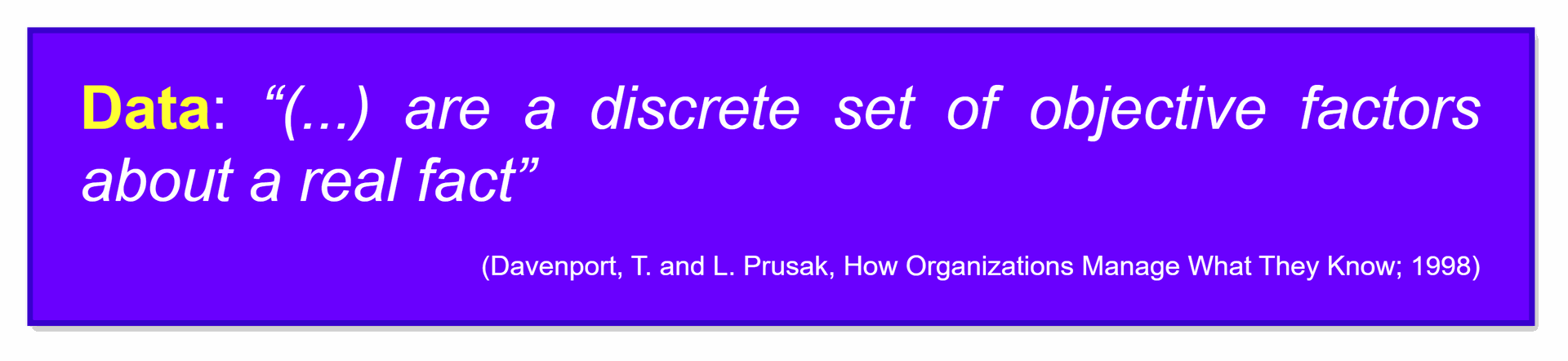
Within a business context, the concept of data is defined as the record of a transaction. Data by itself does not explain the reasons behind things and has little to no relevance. It describes only part of what happens in reality and offers no value judgment or interpretation, so it is not action-oriented.
Decision-making is based on data, but data alone never indicates what to do. Data does not reveal what is important. Nevertheless, data is fundamental because it forms the basis for the creation of information.
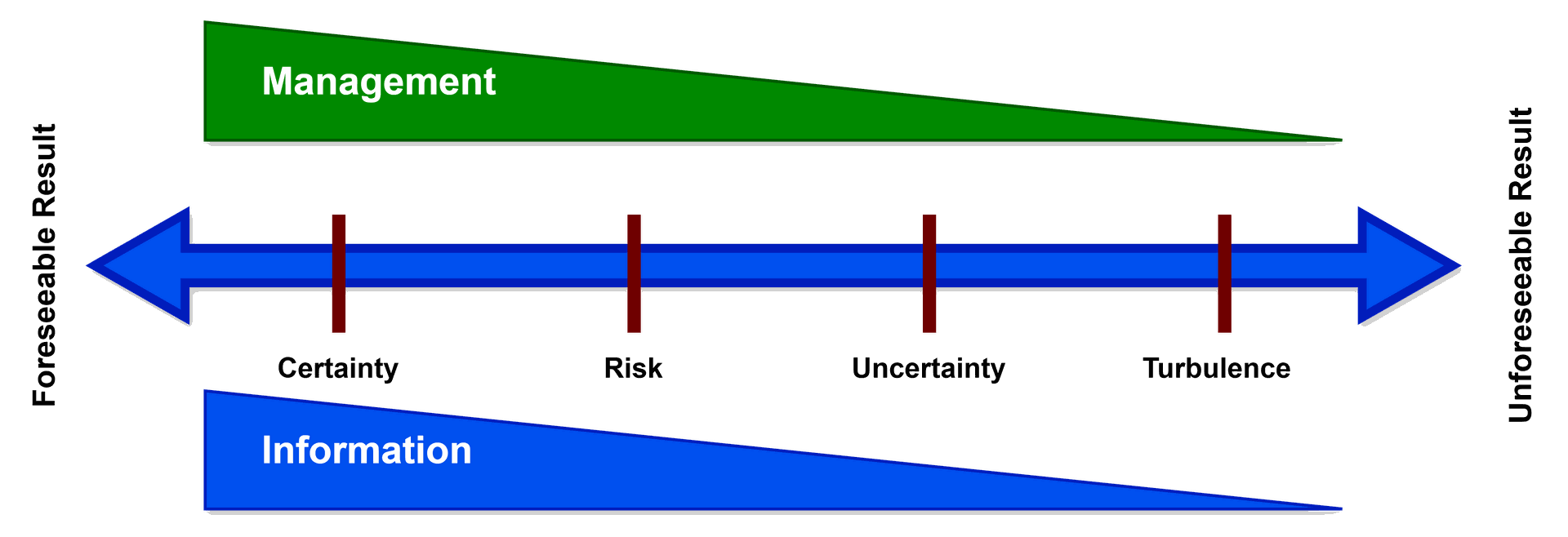
Information can be defined as “a set of processed data with meaning (relevance, purpose, context) and therefore useful for the decision-maker, as it reduces uncertainty.” When information is available, management outcomes become more predictable.
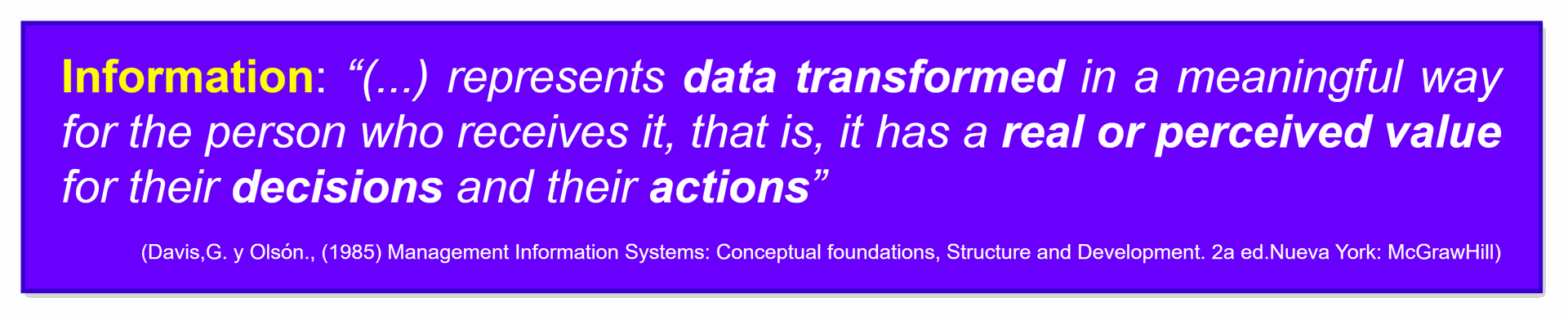
Data can be transformed into information by adding value. This transformation process is characterized by the presence of a unit of analysis, consensus on meaning, and indispensable human mediation.
There will be factors through which the value of information can be evaluated at a given moment and context:
- Quality: refers to the accuracy and the degree of reliability that can be attributed to the information being used.
- Timeliness: determines to what extent the information is “available” to the “right person” at the “right moment” to “take the appropriate action.” This is a critical factor in judging the value of information.
- Quantity: refers to the “sufficiency” of information for a given purpose. It affects effectiveness, since having more information than strictly necessary can hinder decision-making or problem-solving as much as, or even more than, having insufficient information.
- Relevance: is relative to the pursued objective, meaning there is a value relationship where this factor effectively influences the achievement of the goal or is decisive for taking action.
Information management
Here arises a fundamental question: How can we maximize the value of information? The answer lies in the ability to apply techniques (principles, methods, procedures, and tools) to maximize the product of the different value factors. Let’s call this ability: “management.”
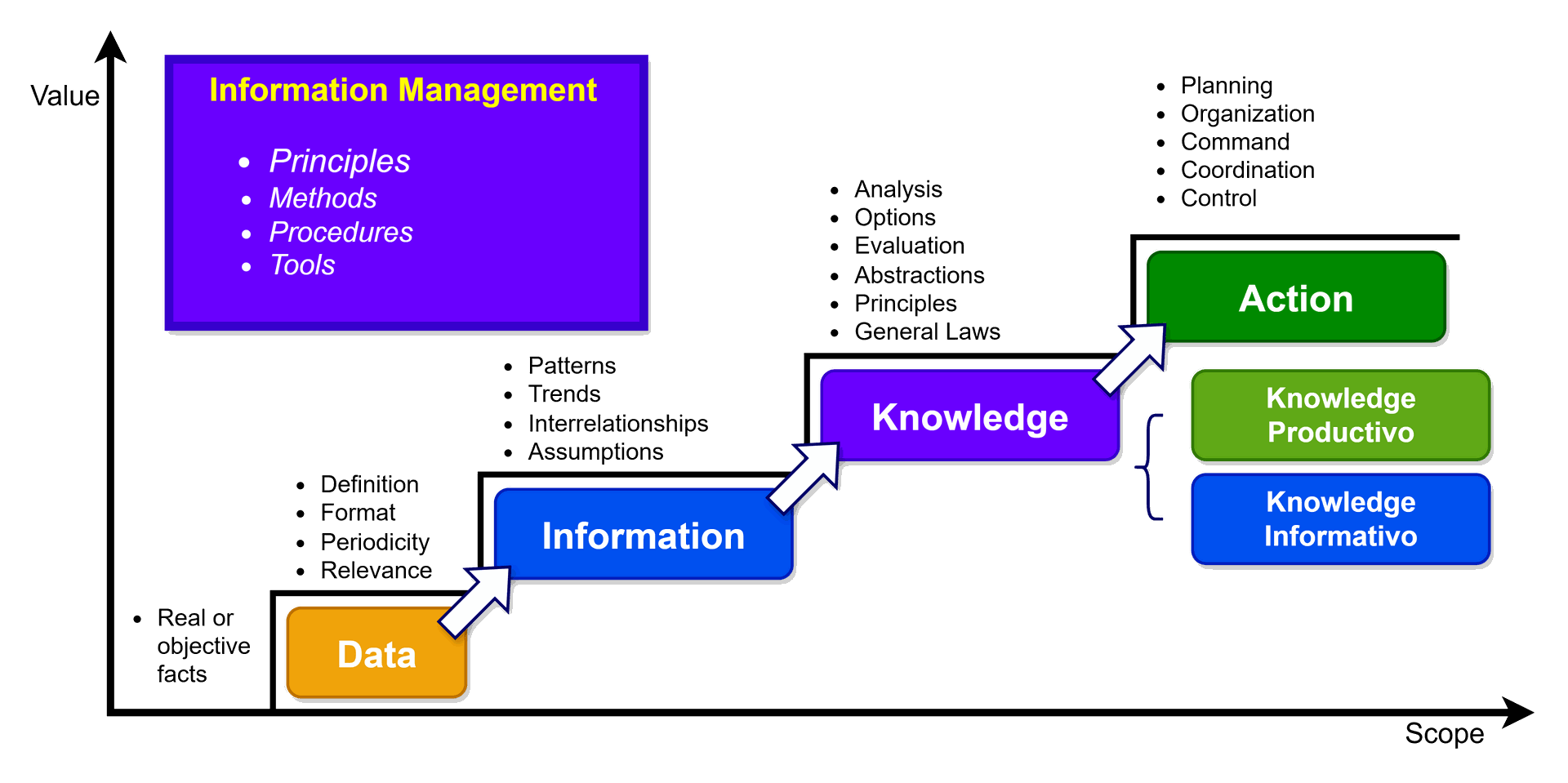
Like any valuable asset, organizations also recognize that data and information assets must be “managed.”
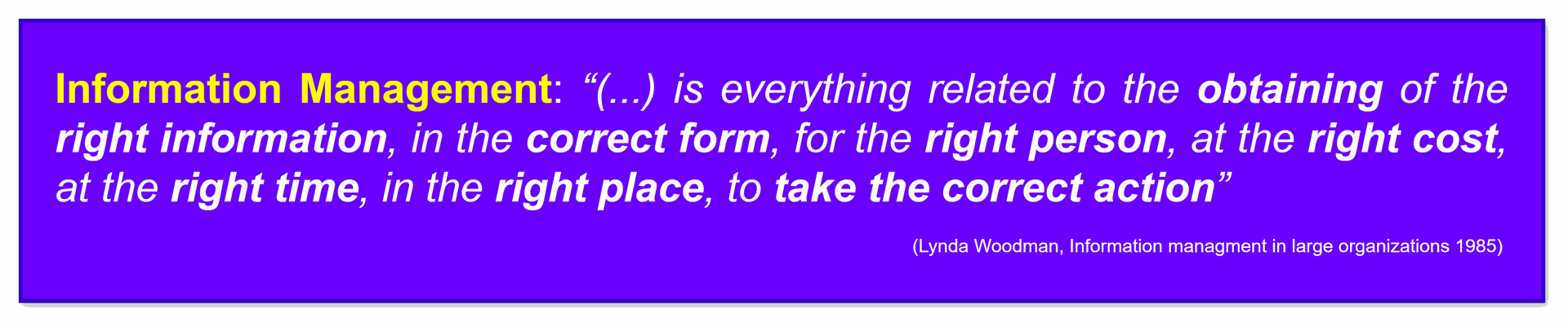
From the definition of “Information Management” in relation to the value factors, we can infer the objectives it seeks to achieve:
- To maximize the value and benefits derived from the use of information.
- To minimize the cost of acquisition, processing, and use.
- To assign responsibilities for the effective, efficient, and economical use of information.
- To ensure a continuous and sufficient supply of relevant information.
The term knowledge is defined as “a mixture of experience, values, information, and know-how that serves as a framework for incorporating new experiences and information, and is useful for action.” Knowledge combines information, context, and experience; it includes reflection and synthesis, is summarized, validated, and goal-oriented. The text distinguishes between informative knowledge, which precedes productive knowledge. In the former, information gains value through analysis; in the latter, it comes from evaluating options, advantages, and disadvantages. Knowledge enables action, which in a business context means exercising management functions.
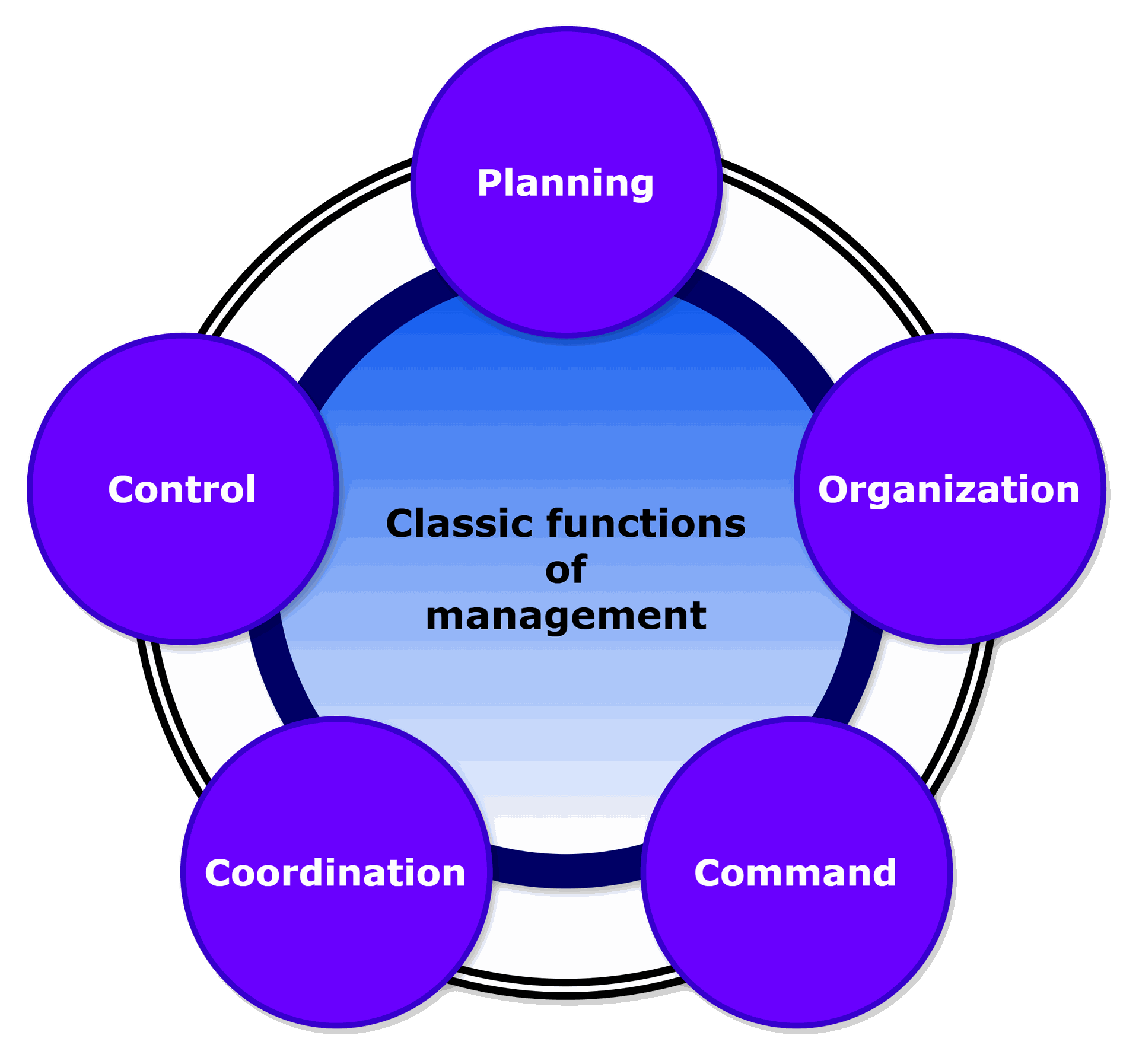
Having considered the what (data, information, knowledge) and the how (management), it is necessary to define the where. Information Management takes place within the organization, closely linked to management processes.
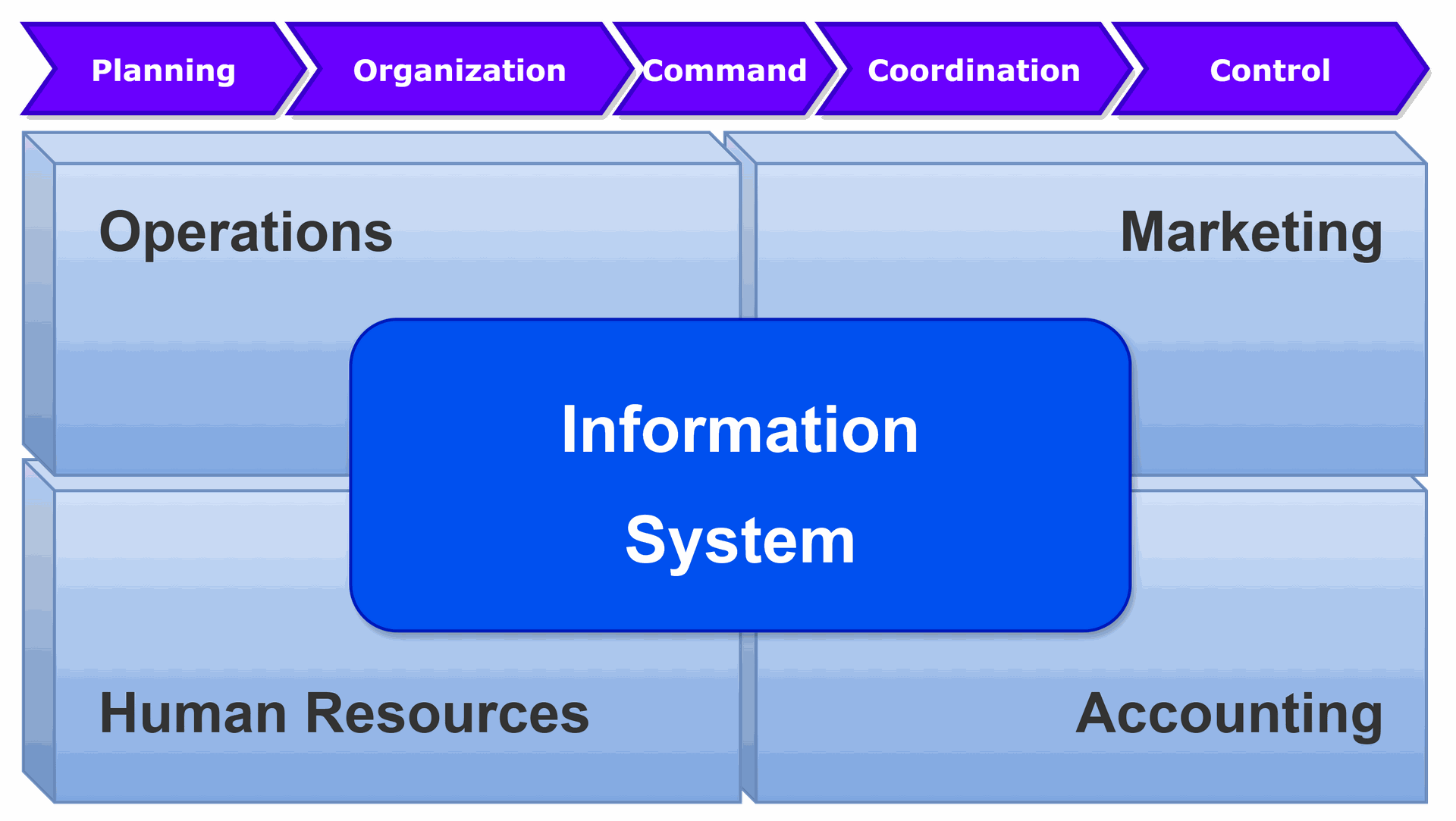
Regardless of the organization, management functions are exercised over the other subsystems. These functions require constant interaction with the organization’s Information System (IS), which integrates people, resources, data and information, technologies, and activities aimed at achieving specific objectives.
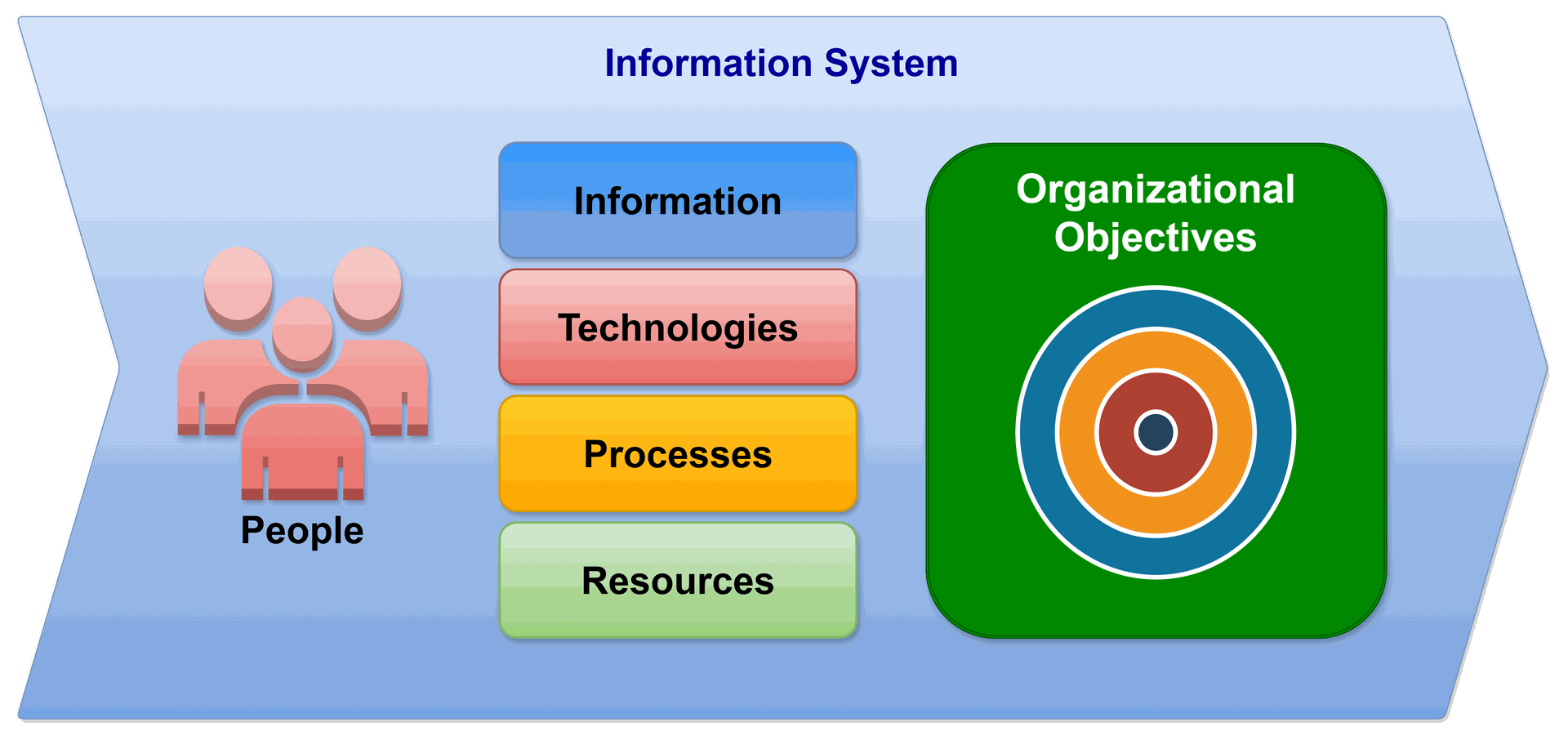
In an Information System, processes, activities, and assigned resources work together synergistically to achieve objectives. However, technologies play an increasingly important role in Information Management, particularly the new Information and Communication Technologies (IT).

Enterprise Information Systems
From the earliest stages of computing development and later networks, a whole world of possibilities opened up regarding Information Systems (IS). The capabilities for information management enabled by IT have led to the emergence of standardized solutions for the operational, tactical, and strategic management levels of organizations. From now on, when we refer to an IS, we mean its implementation with intensive use of IT.
Any modern organization has one or more of these solutions, in which it invests significant resources because of the return they provide. It is useful to know the main examples presented by levels in the following pyramid:
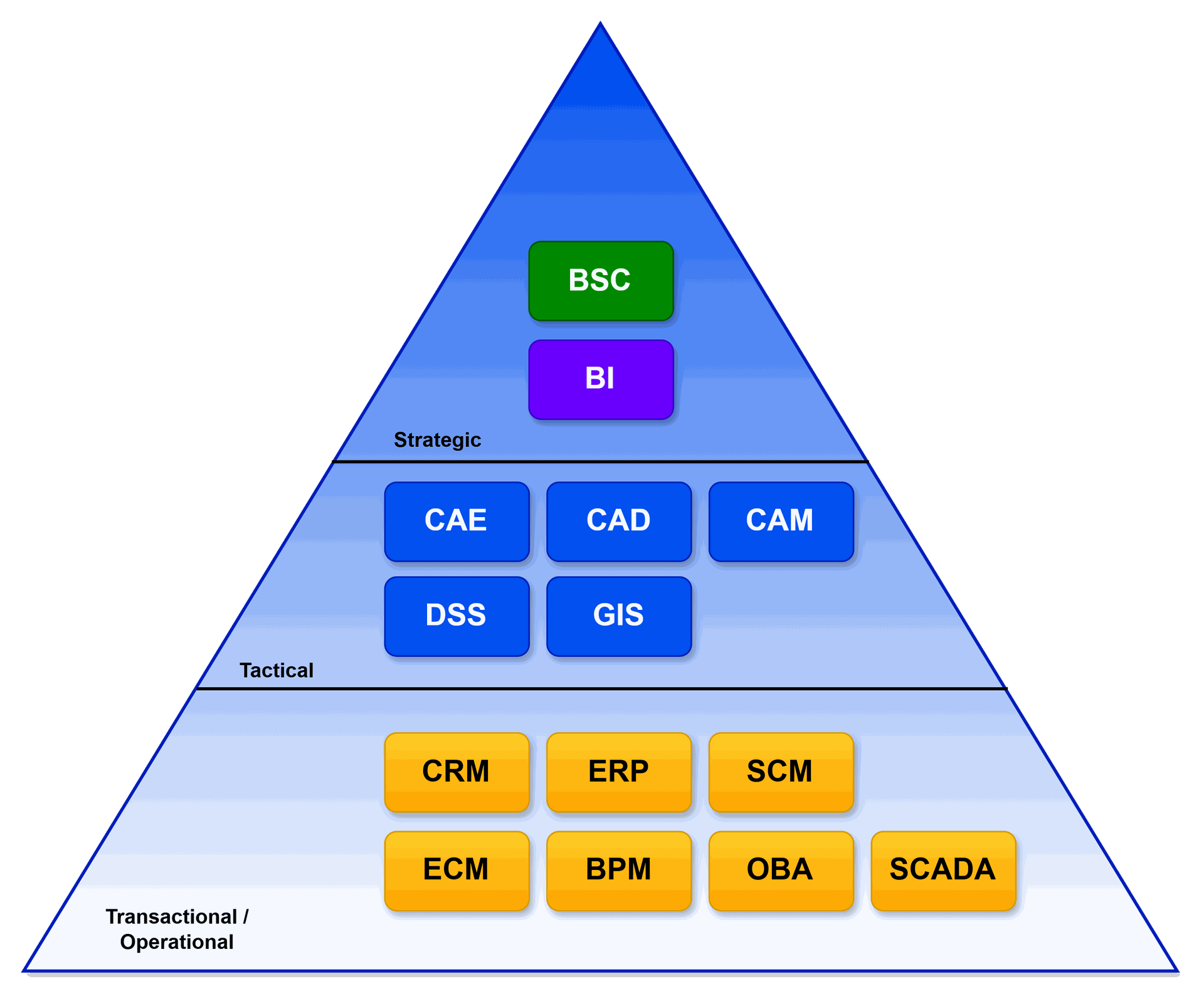
Transactional or Operational Level
The information systems at this level are responsible for ensuring operational functionality among the different subsystems of the organization. They focus more on data than on information, although they may include reporting or dashboard options. They are known as transactional systems because they record the data of business operations (transactions). They focus on managing negotiations or agreements, sales, inventory, warehouses, accounting, and industrial processes. The main standardized examples at this level are:
Customer Relationship Management (CRM)
This business area centers on the customer and focuses on gathering as much information as possible about them to increase the value of the offer. It is directly related to sales (Marketing Subsystem). These systems manage the negotiation process from start to finish, whether a sale is closed or an opportunity is lost.
Enterprise Resource Planning (ERP)
These systems manage production, logistics, distribution, inventory, shipping, invoicing, and company accounting, intervening in activities such as sales, deliveries, payments, production, inventory management, quality management, and human resources management. They have become critical solutions for large companies in the deployment of operational production processes (Operations Subsystem). Some ERPs even extend to CRM, SCM, and other functions.
Supply Chain Management (SCM)
SCM assists in the logistics management process related to procurement. It includes planning, execution, and control of supply operations aimed at meeting customer needs as efficiently as possible. Additionally, it focuses on minimizing the costs associated with this activity. It is directly related to the Operations Subsystem regarding logistics processes, particularly acquisition and inventory management. In some sectors where a Just-In-Time (JIT) strategy can be applied, SCM has contributed to a significant reduction in logistics operating costs.
Enterprise Content Management (ECM)
ECM is the tool that implements the strategies and methods used to capture, manage, store, preserve, and deliver content and documents related to an organization’s processes. ECM covers content management whether the information is presented as a paper document, an electronic file, a report, or even an email. It includes web content management, search, collaboration, records management, workflow management, and document capture and digitization.
Business Process Management (BPM)
BPM is a set of tools designed to model, automate, monitor, and optimize an organization’s business processes in order to improve efficiency, agility, and overall performance. The Business Process Model and Notation (BPMN) standard allows defining and documenting processes for human use and deployment in IT systems by acting as a high-level language in the realm of business processes.
The business process engine is the software component that enables the deployment and execution of a process. It interacts with the other IT components of the business and other information systems.
The BPM suite is the set of tools aimed at end users, whether they are employees or customers of the business. A suite must include at a minimum:
- Modeling Tool: Used to design the process using the graphical elements of the notation; it functions as an integrated development environment for the process.
- Process Portal: This is the end-user tool through which each user involved in the process can perform their part; it functions like a task inbox.
- Process Administrator Console: Allows control over the execution of process instances and can be extended to display execution analytics of the process.
Supervisory Control and Data Acquisition (SCADA)
An application designed for production control, providing communication with field devices in industrial plants. It fulfills three main functions:
- Data Acquisition: To collect, process, and store, in real time, relevant information about a highly automated production process.
- Supervision: To monitor the progress of the process from control panels also called HMI.
- Control: Allows modifying the progress of the process by acting through the equipment involved in process regulation.
Tactical Level
At this level are the middle managers — the management tier that maintains direct contact with both the strategic level and the operational level, acting as a bridge between managerial objectives and execution on the production line. This level includes those responsible for product design, production managers, and department or area heads. Their primary need is for information, so the focus is on synthesizing what is happening in the operations subsystem in order to act upon it. The information systems that typify this level are:
Computer-Aided Design, Engineering, and Manufacturing (CAD, CAE, and CAM)
These involve the use of a wide range of software tools that assist engineers, architects, and designers in the initial conception of medium- and high-complexity products across various fields. The engineering functions provided by CAE enable high-level analysis and simulations of the designs created in CAD. CAM systems assist in the direct manufacturing phase of a product, acting as a bridge between CAD/CAE and the machine/tool interfaces, with minimal human operator intervention. These systems have a significant impact on manufacturing by standardizing product development, reducing design, testing, and prototyping efforts, enabling lower production costs, and improving productivity and quality.
Decision Support System (DSS)
These are systems that deeply analyze data sets to provide optimal alternative courses of action in a decision-making process. DSSs rely on robust models derived from branches of mathematics such as Operations Research. Their use is essential in certain operational areas, as they can help reduce costs and increase productivity.
Geographic Information Systems (GIS)
These are systems designed to support decision-making based on geographically referenced information. This solution consists of various integrated tools that include cartographic functions, information retrieval functions, and presentation/analysis functions. The components commonly found in these systems are:
- Cartography and Spatial Data Infrastructure: This includes maps, layers of interest (such as those associated with the political-administrative division of a territory), and standardized, agreed-upon metadata.
- Geospatial Database: This is the software component that stores all the information of the GIS and implements specialized primitives to retrieve and process the information.
- GIS Server: Software component responsible for interacting with the database and providing an interface to end-user applications. It can be said to provide the services that enable the management of geospatial information.
- GIS Editor: Software component focused on producing geographic information (maps and data).
- GIS Viewer: Software component aimed at the end user, providing tools for navigation, interaction, and analysis. Depending on its scope, it may include real-time visualization.
Strategic Level
Information systems at the strategic level are aimed at the company’s top management. They use language that translates information into metrics, indicators, and objectives to show whether initiatives and key decisions are on track or whether the plan needs to change. At this level, a high degree of synthesis is achieved regarding the functioning of the company’s subsystems. Key Performance Indicators (KPIs) include profits, return on investment, customer service, process efficiency, and staff capability.
Business Intelligence (BI)
Solutions encompass a set of tools that support concepts and methods to improve business decision-making through fact-based systems that draw on transactional-level information. They generally offer a model for integrating data from heterogeneous sources while enabling capabilities to obtain information and knowledge from them, providing high practical value. An essential characteristic is their user orientation, which separates users’ technical knowledge from their ability to use these tools. BI solutions typically focus on building data marts or historical data warehouses and analytical dashboards. Data marts allow analysis of information based on a specific fact (sales, incidents, etc.) across related dimensions.
Balanced Scorecard (BSC)
It is a tool that makes an organization’s strategy visible. It structures a strategy map based on the perspectives of financial performance, customer knowledge, internal processes, and learning. It links initiatives with objectives, measures, and indicators. In practice, it defines key performance indicators and consistently displays them through a dashboard fed by timely information from transactional and strategic information systems.
Technologies and Paradigms
Up to this point, we have seen what could be called the classic elements of the information systems vision. However, this post would be incomplete without at least mentioning the technologies and paradigms that currently make a difference for businesses. We will leave the details of each for other works, so we will not go in-depth into their applications.
Service-Oriented Architecture (SOA)
It is an IT strategy that enables full integration of information systems and responds quickly to new needs and opportunities. It allows leveraging system features for the deployment of new business models. It reuses organizational system assets by adding new value to them.
Cloud Computing
It has become a key IT provisioning strategy. It provides companies with platforms, infrastructure, and applications as services, constituting a new paradigm in IT strategy implementation focused on cost reduction and scaling capabilities according to demand requirements.
Web 2.0 and Social Networks
Web 2.0 prevails today and is the foundation of the social media revolution. The paradigm shift lies in web browsers implementing standards that allow for a rich multimedia experience. Social networks have proven to be a new medium to channel sales through different strategies, some more ethical than others.
Smart Devices and Mobile Applications
They have undoubtedly had a profound impact on our lives, for better or worse. We depend on them to be more effective in our daily activities, as they let us handle business matters anytime, anywhere, and easily. New business models constantly emerge around them.
Internet of Things (IoT)
If our connectivity to the internet and technology didn’t seem enough, now “things” have joined in, too. In this paradigm, everyday devices began to interact in a new way through data exchange with applications and people. Light bulbs, smart accessories, clothing, medical equipment, and even cities now interact with us by fulfilling our wishes or providing status feedback.
Data Mining and Big Data
These have emerged as important topics in Data Management. Data mining is a necessary tool for extracting knowledge from data and information, aiming to build multi-variable models that support decision-making based on initial conditions related to the environment or process indicators. In other scenarios, it helps identify patterns, generalizations, non-obvious trends, and valuable insights for decision-making. Big Data is an evolution of data mining but is more closely tied to the computing paradigm for handling data volumes that exceed the capabilities of traditional systems. Big Data arises from the need to extract knowledge from the growing datasets generated by social networks, SCADA systems, non-relational databases, IoT, among others.
Artificial Intelligence (AI), Machine Learning, and Deep Learning
These are related to data mining but differ by focusing on creating new knowledge through artificial intelligence agents (AI algorithms) trained to identify regularities, patterns, rules, generalities, and abstractions. They also produce models that can be queried to obtain results that support decision-making or assist experts in specific processes.
Augmented and Virtual Reality (AR/VR)
Augmented reality uses display devices to overlay virtual elements onto the field of view, so users perceive them as part of the real world. Meanwhile, virtual reality aims to develop completely virtual environments where users can interact through an avatar. Both concepts aim to enhance our perception of reality or materialize our imagination, with countless possibilities.
Blockchain, Cryptocurrencies, and Non-Fungible Tokens (NFTs)
Blockchain is a secure, distributed database technology for the anonymous recording of transactions using cryptographic techniques. Blockchain technology has potential applications in various scenarios, although it is best known as the foundation of cryptocurrencies. These use the blockchain to maintain a public ledger of transactions, ensuring the attributes inherent to exchange values (money) and generating the necessary consensus for their use as currency in the real economy. Another interesting application of blockchain technology comes from Non-Fungible Tokens (NFTs), which standardize the concept of extraordinary value associated with works of art. In fact, their main use lies in attaching the token to unique representations that have an owner recorded on the blockchain. The trade of digital artworks, the emergence of a market for unique or collectible items, and the buying and selling of game items and characters are some of the first uses of this technology. A key aspect of these technologies is that we are witnessing a new form of exchange value, much like gold in its time and later paper money. At the same time, current exchange values are being converted into these technologies, enabling their convertibility and use in the real economy.
Brain-Computer Interfaces (BCI)
The concept is to acquire information from neural activity, decode the semantics of these signals, and activate an actuator mechanism that faithfully responds to the person’s thoughts and will. A second generation of these interfaces would allow bidirectional exchange so that sensory perception can be encoded and transmitted through the nervous system to be perceived by the conscious being. This has been approached from two paths: the invasive approach, which involves directly implanting devices in the brain, and the non-invasive approach, which captures and translates electrical activity through devices external to the body.
Web 3.0 and Metaverses
Just as the inclusion of standards for multimedia content on the web marked the transition between the first and second generation, integrating these technologies marks a new revolution. This change introduces semantics into web content, enabling the application of AI algorithms, data mining, the natural integration of IoT, intensive use of AR/VR technologies, and the native implementation of value forms such as cryptocurrencies and NFTs. We must be clear about one thing: all this leads to the idea of virtual worlds in their nascent yet purest concept—the metaverse. We must understand that technologies have reached or are emerging at a point where they can represent the nature of social relationships (in all their philosophical complexity). Therefore, the leap from the real world to the metaverse will be seen as another step in the evolution of our species’ relationship with technology. Its profound impact is still unimaginable, but it will radically change how business is conducted, how work is done, and how life is lived.
The future is interesting—or at least it seems so. We stand at the threshold of a true revolution in information systems and how they will generate new forms of value that blend with existing ones. It is necessary to stay informed about the use cases of these new technologies and the business models they will ultimately orchestrate as development progresses. Many issues remain, and many questions remain unanswered; some are economic and business-related, some are difficult and involve social, political, or ideological matters, and others may be more subjective or spiritual in nature. Time will determine how relevant these prove to be, but one thing is certain: the journey has begun, and its course will be unstoppable.
References
- Davenport, Thomas & Prusak, Laurence. (1998). Working Knowledge: How Organizations Manage What They Know.
- Davis, Gordon & Olson, Margrethe. (2022). Sistemas de información gerencial.
- Kaplan, Robert & Norton, David. (1996). The Balanced Scorecard: Translating Strategy Into Action.
- Woodman, Lynda. (1999). Information Management in Large Organizations.
Armando Robert Lobo — March 11, 2022